
Performance Management Consultancy for Real Growth Conversations
Let’s Talk Talent builds the framework, cadence, and conversation skills for performance management across the UAE’s multicultural, hybrid, mobile workforces. Most organizations don’t have a performance management problem; they have a performance conversation problem: the form gets filled in, the ratings get moderated, and nothing about how anyone works actually changes.
We design performance management that managers will use and employees will trust, built to do two jobs at once: improve what people deliver today and reveal what they could take on next. That evidence feeds directly into career and capability frameworks, sharper people strategy decisions, and the management and leadership skills your managers need to run the conversation well.
How Let’s Talk Talent Can Help Your Team

Performance Management Services
Every engagement starts with your business context, not a framework. We want to know how work gets done, what your managers dread, and what your leaders believe performance management is for. Only then do we look at objectives, cadence, or ratings.
The work is modular. Some organizations need the whole system rebuilt; others need one strand done properly, such as a check-in rhythm that survives a busy quarter. We deliver through diagnostics, design sessions, workshops, bootcamps, and coaching, in person, virtually, or hybrid. This pillar sits alongside the rest of our HR and organizational development consultancy.
Performance Management Framework Design
Building a system that fits how your organization actually works.
A performance management framework sets out what gets agreed upon, how often people talk about it, and what happens next. We design it end to end: objective-setting method, check-in cadence, review points, the outcome-and-behavior balance, and whether ratings earn their place.
Ratings are the argument every organization has. Some need one for pay decisions to be defensible; others get more from a narrative summary and an honest calibration conversation. We show the trade-offs rather than arriving with a fixed view.
Goal setting is where frameworks succeed or fail. We help you choose between OKRs, SMART objectives, or a blend and write them to be revisited quarterly rather than rediscovered in November. Where performance links to pay or progression, we make that linkage explicit and connect it to the leveling work in careers and capability.
- Performance framework and policy design, including cadence and review points
- Objective setting: OKRs, SMART goals, and the outcome-versus-behavior balance
- Ratings, no-ratings, and calibration design, with the trade-offs made explicit
- Values and behaviors built into the framework, not bolted on afterwards
- Reward, recognition, and progression linkage, defined clearly and fairly
Best for: organizations moving away from the once-a-year appraisal, businesses scaling past 100 people with no consistent process, and HR teams whose framework is ignored.
Continuous Performance Conversations & Manager Capability
The framework is the easy part. The conversation is the job.
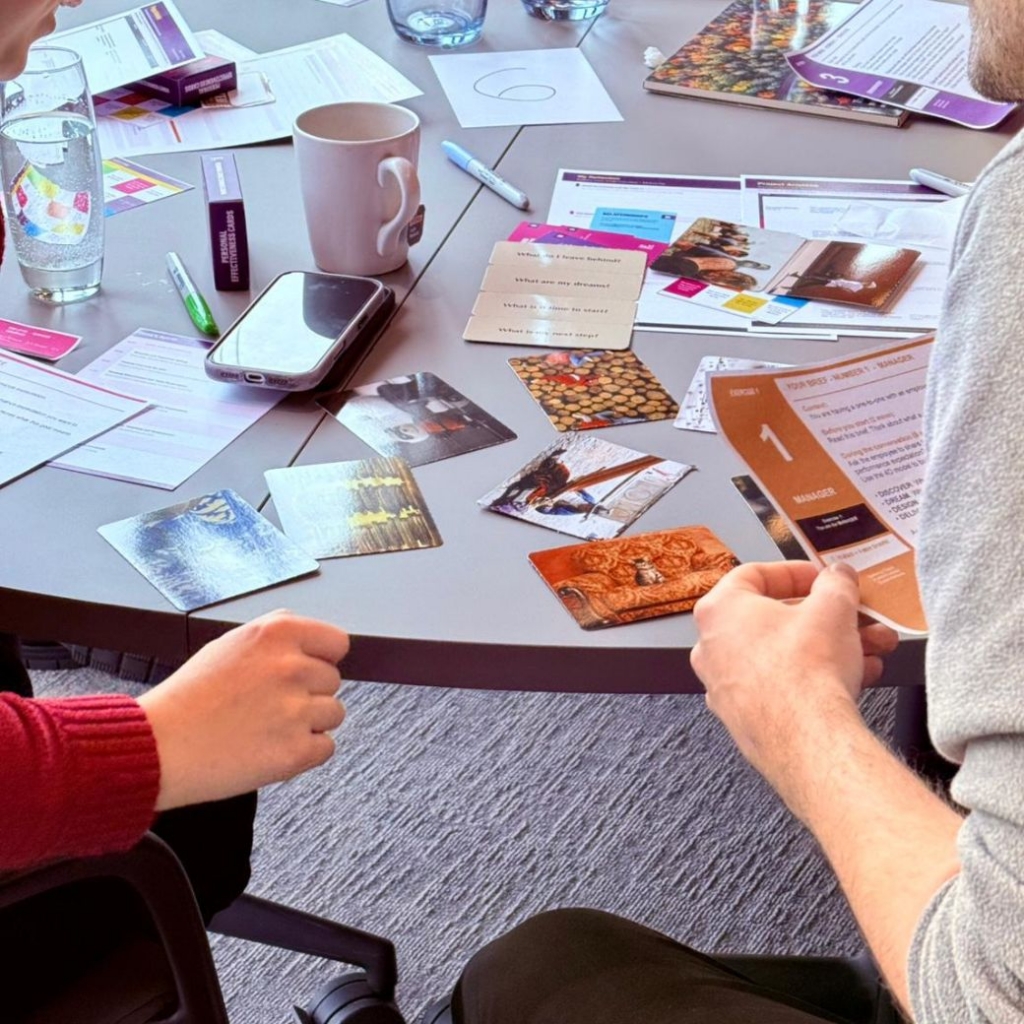
Continuous performance management replaces one long backward-looking meeting with short, regular, forward-looking ones. In practice: a monthly or fortnightly one-to-one with a light structure, feedback that does not wait for a review cycle, and a quarterly check that holds no surprises.
Managers are the delivery mechanism, and most were promoted for being good at their previous job. We build the skills the cadence demands: feedback that lands across cultures rather than only in the sender’s, coaching-style one-to-ones rather than status updates, and difficult conversations held early. That runs through workshops, focused sprints, our people management bootcamp, and coaching.
Underperformance deserves particular care. Handled late, it becomes a grievance or an exit; handled early it is usually a conversation about clarity, capability, or circumstance.
Broader manager development sits in our management and leadership pillar.
- Check-in and one-to-one design, with a structure managers will actually follow
- Feedback skills: giving it, receiving it, making it routine rather than annual
- Difficult conversations and early, fair handling of underperformance
- Coaching-style management, supported by our coaching services
- Employee-side skills: preparing for check-ins, self-review, asking for feedback
Best for: organizations where managers avoid the review conversation, distributed multicultural teams needing deliberate contact points, and businesses promoting first-time managers.
Performance Diagnostics, Calibration & Measurement
Finding out what is really happening before you redesign anything.
We start most performance work with a diagnostic: manager and employee focus groups, a review of your documentation and completion data, leader interviews, and a look at how ratings have been distributed. It takes four to eight weeks and consistently surfaces something leaders did not know.
Calibration keeps the process fair across managers. We facilitate sessions that compare like with like, challenge inflation, surface bias in rating language, and produce decisions leaders can explain. Where objectivity matters most, we bring in assessment, drawing on over 40 tools, including Hogan, Saville Wave, KFLA, the GC Index, DISC and Insights, plus our own live and online 360s.
Measurement then proves the framework is working. We agree on a short set of indicators before launch: check-in completion and quality, rating distribution and drift, fairness scores, retention among strong performers, and how quickly underperformance is addressed. Reviewing those quarterly keeps the process alive.
- Performance management diagnostic and current-state review
- Calibration design and facilitation, including bias and inflation checks
- 360-degree feedback, live and online, individual and team
- Psychometric and strengths assessment where objectivity is needed
- Performance measurement framework and quarterly reporting for the board
Best for: organizations whose ratings no longer distinguish between performers, HR teams asked to evidence fairness, and leaders who suspect the process is failing.

What is Performance Management?
Performance management is the ongoing process of setting clear expectations, giving regular feedback, reviewing progress, and developing capability so that each person’s contribution connects visibly to the organization’s goals. It is a continuous cycle, not an annual event, and its purpose is to improve performance rather than simply record it.
In practice it covers objective setting, check-ins, in-the-moment feedback, formal review points, calibration, development planning, recognition, and the fair handling of underperformance. It applies to everyone, from graduates to executives.
Performance management is not the appraisal, and it is not the software. A performance appraisal is a single event that looks backwards and records a judgement; performance management is the continuous process that shapes what happens next. The appraisal is one moment inside the cycle. A performance management system, likewise, is the framework of expectations, conversations, reviews, and development an organization runs, and the platform is only where some of it gets recorded.
That distinction matters commercially, so we will say it plainly. We don’t sell, resell, or implement HR software and have no partnership with any HRIS or performance platform. We are deliberately technology-agnostic. We design the process, the cadence, and the manager capability that make any system work, whether you run performance in a platform, inside your HRIS, or in a shared document. Our advice is never steering you toward a license.
The Performance Management Cycle
Performance management runs as a repeating cycle with five stages. Most organizations complete stages one and four and lose the value in the other three.
1 – Plan. Agree on objectives, expectations, and behaviors aligned to team and organizational goals.
2 – Do. People carry out the work, with managers coaching in the flow rather than waiting for a review date.
Check in. Hold regular one-to-ones, monthly or fortnightly, to review progress, give feedback both ways, and adjust objectives as priorities change.
3 – Review. Take a formal look back at an agreed point, summarize performance against outcomes and behaviors, then calibrate across managers for fairness.
4 – Develop. Turn the review into a development plan, recognition or a progression decision, then reset objectives and begin again.
The stages are sequential but the cycle is continuous. Stage three is where the process lives or dies, because it is the only stage that happens more than twice a year.
Why Performance Management Fails
Performance management systems usually fail for behavioral reasons, not design reasons. The framework is rarely the problem; nobody was equipped or expected to use it properly. The causes we see most often:
It was designed for HR, not for managers. If the process exists to produce a compliance rate, that is what managers will produce.
Managers were never taught the conversation. Giving developmental feedback and naming a gap early are learned skills, and they land differently across cultures. Few organizations teach them before launching a new framework.
Objectives are set once and never revisited. Goals written in January against a plan that changed in March make the review feel like theater.
The rating overshadows the conversation. When a number attached to pay is the real outcome, both sides negotiate rather than talk honestly.
Underperformance is avoided until it is an exit. Small, early, kind conversations prevent most formal processes, and avoidance is visible to the team.
The process is bolted onto a system rather than built around the work. Buying a platform before agreeing on what good looks like puts the tool in charge of the design.
It only ever looks backwards. A process built to record what happened cannot build what comes next. If the review never asks what someone is now capable of, the organization throws away its clearest evidence of who is ready for more.
Nothing visibly happens as a result. If reviews do not influence development, progression or recognition, people learn the exercise is decorative.
Fixing these is culture work as much as process work, so our redesigns pair the framework with manager development and, where needed, change and transformation support.
Performance Management and Potential: Why They Belong Together
Performance is what someone delivers. Potential is what they could become. Most organizations manage the two through processes that never speak to each other: the performance review looks back at the last six or twelve months, while talent and succession planning looks forward at who might be ready for more. So people get managed for what they did last quarter, or earmarked for a future that never reaches their day-to-day work.
They should feed each other. What someone delivers now is the clearest evidence of what they could do next, and the development you invest in only pays back when it shows up in the job. In practice that means reviewing conversations that name capability as well as outcomes, objectives written to stretch someone rather than only to be hit, and talent reviews drawing on what managers are already seeing week to week instead of a separate round of nominations.
This is the part of the work we care most about. Let’s Talk Talent designs performance management so that it grows people, and career and capability work so that the growth shows up in performance. We do not wait for performance to reveal potential, and we do not develop potential that never appears in the day job. For the other side of that work, including career frameworks, leveling, and progression routes, see our careers and capability pillar.
Why Performance Management Matters to Your Business

Effort pointed at the right things
Cascaded objectives mean people spend time on work that moves the organization forward.
Problems caught early
Regular check-ins surface blockers and slipping delivery while there is time to act.

Better, more defensible decisions
Calibrated performance data makes pay and promotion decisions easier to make and to explain.

Managers who feel equipped
Managers stop dreading the process once they have a structure and the skills to run the conversation inside it.

Retention of your strongest people
High performers stay where their contribution is noticed and developed, not assumed, a difference that shows up quickly in a market where the alternative offer is often already in play.

Fairness people believe in
Consistent standards and honest calibration reduce the perception of favoritism that erodes trust fastest, particularly important in a workforce made up of many nationalities and expectations of “fair”.
How Let’s Talk Talent Approaches Performance Management
1 – Discover. We meet your leadership team, HR team, managers, and employees to understand how performance is handled today and what the business needs from it.
2 – Diagnose. We test the current state with evidence: focus groups, interviews, completion and rating data, engagement insight, and a documentation review.
3 – Design. We co-create the framework in facilitated sessions, agreeing on objectives, method, cadence, review points, ratings approach, and measures.
4 – Deliver & Embed. We build manager and employee capability through workshops, bootcamps, and coaching, support the launch, and then review how it lands.
Typical timescales: a diagnostic usually runs 4 to 8 weeks, designing a new framework typically takes 3 to 6 months, and a full rollout including manager enablement generally runs 6 to 12 months.
Who this is for: HR directors, people directors and chief people officers, founders and COOs introducing performance management for the first time, and heads of talent and L&D.
Our Clients
We work with organisations that take their people seriously, from global media and entertainment names to research institutions, charities and fast-growing specialists. Clients include Lifearc, ForGood Tech, the Mental Health Foundation, Kings Fund, Bupa and Nokia.

Performance Management FAQs
What is performance management?
Performance management is the ongoing process of setting expectations, giving feedback, reviewing progress, and developing capability so that individual contribution connects clearly to organizational goals. It is continuous rather than annual and developmental rather than administrative. Let’s Talk Talent designs it as a cycle of conversations supported by a light framework, not a form to complete each December.
What is a performance management system?
A performance management system is the complete set of processes an organization uses to align, review, and develop employee performance: objective setting, check-ins, feedback, reviews, calibration, and development planning. It’s not the software, although software often records it. We’re deliberately technology-agnostic, designing the system and leaving the platform choice to you as part of our people and organizational development services.
Why is performance management important?
Performance management is important because it’s how organizations turn strategy into individual effort and how people find out whether their work matters. The benefits are clearer priorities, earlier problem-solving, fairer pay and promotion decisions, stronger retention of high performers, and more confident managers. We find it the biggest single lever on manager credibility, which is why we pair framework design with management and leadership development and people and team development.
What is the performance management process?
The performance management process runs in five repeating stages: plan, do, check in, review, and develop. You agree on objectives, people work with coaching along the way, one-to-ones track progress, a formal review calibrates performance, and then development decisions follow before the cycle resets. Let’s Talk Talent tailors the cadence to your organization.
How does performance management link to talent and succession planning?
Performance management should be the main evidence base for talent and succession planning. What someone delivers now, and how they deliver it, is the clearest signal of what they could take on next, so check-ins and reviews should feed your talent reviews rather than running in parallel with them. Let’s Talk Talent designs the two to connect, so development decisions rest on real performance, and the growth people are promised shows up in their day-to-day work.
Why do performance management systems fail?
Performance management systems usually fail for behavioral reasons, not design flaws. Managers are not taught the conversation, objectives are never revisited, the rating overshadows the discussion, the process only ever looks backwards, underperformance is avoided until it becomes an exit, and nothing visibly changes afterwards. Let’s Talk Talent tackles those causes by building manager capability alongside the framework.
Is performance management the same as a performance appraisal?
No. A performance appraisal is a single backward-looking event that records a judgement, while performance management is the continuous process of expectations, feedback, review, and development surrounding it. An organization can run appraisals diligently while managing performance badly. Let’s Talk Talent shifts the weight from the annual event to the everyday conversation, supported by workshops and bootcamps.
How do you measure whether performance management is working?
Measure it with a short set of indicators agreed before launch, not completion rates alone. Useful measures include check-in frequency and quality, rating distribution and drift, fairness scores in engagement surveys, retention of strong performers, and how quickly underperformance is addressed. Let’s Talk Talent builds this reporting into the design, supported by 360-degree feedback and assessment.
How long does it take to redesign performance management?
A performance management diagnostic typically takes 4 to 8 weeks, designing the new framework usually runs 3 to 6 months, and a full rollout, including manager enablement, generally takes 6 to 12 months. Smaller organizations move faster. Let’s Talk Talent scopes the timeline upfront and can start with the diagnostic alone.
Does performance management work for hybrid, remote, and multicultural teams?
Yes, and distributed teams often need it more, because visibility cannot be assumed. In the UAE, teams often span nationalities, working weeks and time zones, and a lightly designed process breaks quickly in that context. We design deliberate contact points, written objectives everyone can see, asynchronous feedback routes, and review timing that works across time zones. Let’s Talk Talent delivers in person, virtually, and hybrid.
How can Let’s Talk Talent help us improve performance management?
Let’s Talk Talent can diagnose what is going wrong, redesign the framework, build the manager capability to run it, and stay involved while it beds in. Ongoing support includes refresher workshops, manager coaching, calibration facilitation, and quarterly reviews, plus programs from our learning and development team. Every engagement is scoped and quoted after a free discovery conversation.
Ready to Make Performance Conversations Worth Having?
Tell us what happens in your organization today and we will say honestly whether you need a redesign, a rebuild or better-equipped managers. The first conversation is free, with no obligation.
Case Studies
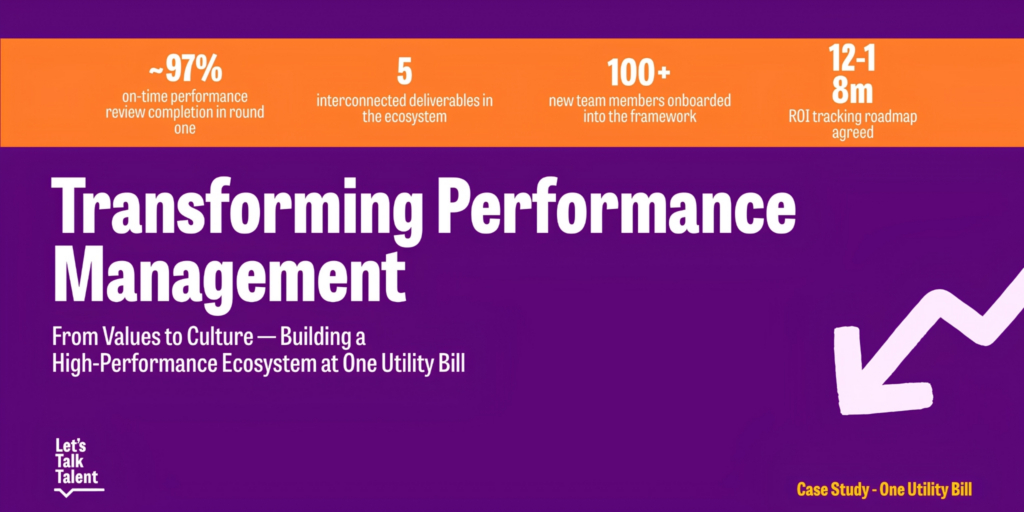
Transforming performance management at One Utility Bill—a fast-growing business given a framework, objective-setting approach and conversation structure that fitted how it actually worked.
Transforming performance management for a global tech company—a large, distributed organisation moved to a consistent approach, with managers equipped to run it across regions.
Developing scalable management and leadership capability at ManyPets—manager capability built at pace, so growth did not outrun everyday people’s conversations.
More client work sits in our case study library.
People & Team Development Resources
We publish practical guidance for HR leaders, people directors, and team managers who have to make development work with real budgets and real diaries. Start with these.
Performance reviews: necessary evil or missed opportunity? — why the annual review has such a poor reputation, and what to do instead of scrapping it.

Career growth and performance management—how performance and career conversations feed each other.
Preparing employees to become great managers—the skills first-time managers need before they review anyone.
10 questions every leader should be asking about talent—prompts for your next leadership conversation about performance and capability.
Everything else lives in our learning and insight hub.