
HR & People Strategy Consultancy
Let’s Talk Talent is an HR and people strategy consultancy in Dubai and London, building people strategies that connect to the business plan, the budget, and the next three years of hiring, development, and succession designed for the UAE’s multicultural workforce and high-mobility labor market. Most organizations don’t lack ambition for their people; they lack a written strategy that connects that ambition to the numbers.
We build a strategy short enough to remember and specific enough to act on, where performance and potential feed into each other rather than running on separate tracks, drawing on performance management data, career and capability frameworks, and the practicalities of leading change and transformation. Backed by 30 years of global practice and our 2025 HR Consultancy of the Year award.
How Let’s Talk Talent Can Help Your Team
HR & People Strategy Services
Every engagement starts with business context, not with an HR framework. We want to understand the growth plan, the operating model, the commercial pressures, whether you sit on the mainland or in a free zone, and the board’s appetite for change before we look at a single people process. That is what stops a strategy becoming a document nobody opens.
From there the work is modular. Some organizations need the whole picture built from scratch. Others need one piece done properly: a succession plan, an EVP, an onboarding redesign, a skills gap analysis, or an Emiratisation development pathway. Take a single strand or the full set, delivered through diagnostics, facilitated leadership sessions, interactive workshops, and hands-on implementation support. Everything is co-created with your team, so the capability stays in the building when we leave. Our wider HR and organizational development consultancy shows how this pillar connects to the rest.
HR & People Strategy Development
Turning your business plan into a people plan your leaders will back.
An HR strategy is only useful if it names priorities and drops things. We work with you to define three to five people’s priorities for the planning period, agree what success looks like for each, and map the interventions, owners, and milestones underneath. The output is a strategy on a page, supported by a delivery roadmap.
Diagnostics come first. We use stakeholder interviews, employee listening, people data analysis, and culture diagnostics to establish where you actually are, rather than where the last engagement survey said you were. That includes a skills gap analysis: the capabilities your plan needs, set honestly against the capabilities you hold today, across a workforce that in the UAE is typically drawn from dozens of nationalities and working cultures.
We then build the operating rhythm around the strategy. How HR reports on it, how the board reviews it, how it flexes when the commercial plan changes.
If learning is central to your priorities, this joins up directly with your L&D strategy so development spend follows the strategy rather than the loudest request.
- People strategy on a page, with priorities, owners, and measures
- Organizational diagnostics: interviews, focus groups, people data review
- HR operating model and HR team capability design
- Skills gap analysis and capability mapping against future roles
- People analytics: the small set of metrics your board should see quarterly
Best for: newly appointed HR or People Directors writing their first strategy, businesses scaling past 100 people without an HR blueprint, and organizations whose people plan has fallen out of step with a new commercial strategy or a shift between mainland and free zone operations.
Talent Management, Succession & Workforce Planning
Knowing who you have, who you need, and who is next.
Workforce planning answers a question that is simple to ask and surprisingly hard to evidence. Do you have the right people, in the right roles, with the right skills, at the right time? We help you model demand against your growth plan, compare it with the capability you already hold, and turn each gap into a build, buy, or borrow decision, a question the UAE labor market makes especially live, where skilled people can be recruited quickly but can also leave just as quickly.
Succession planning is where most organizations are most exposed. We map critical roles rather than simply senior ones, identify successors across ready-now, ready-soon, and ready-later horizons, and build the development plans that move people between them. Where Emiratisation is part of your workforce plan, succession is one of the most useful places to build national talent into a genuine pipeline rather than a headcount target.
Underneath both sits talent management. How you identify potential, how you talk about it honestly, and how you develop it. We draw on over 40 assessment tools where objectivity matters, including Hogan, Saville Wave, KFLA, the GC Index, DISC, Insights and our own live and online 360-degree feedback programs.
All of this is usually owned by different people, run on different calendars, and never compared. Workforce planning sits with HR and finance, succession with the executive team, and performance management with line managers, so the organization cannot answer the question underneath all of it: are the people delivering today the people who could lead tomorrow?
We build them to be read together. What someone delivers now becomes the evidence behind a succession decision, and the development agreed through your career and capability frameworks shows up in what they deliver next.
- Strategic workforce planning and scenario modelling
- Critical role mapping and succession bench reviews
- Talent identification, potential assessment, and calibration sessions
- Nine-box and talent review design that managers can actually run
- Retention risk analysis for business-critical people in a high-mobility market
Best for: founder-led businesses with key-person risk, organizations preparing for investment or exit, and HR teams asked by the board to evidence their leadership pipeline and Emiratisation progress.
Employee Experience, EVP & Onboarding Strategy
Making the promise you make to candidates true on day 90.
Your employee value proposition is the deal you offer people: what they give, what they get, and what makes working with you different from working somewhere else. In the UAE, where nine in ten employees are expatriates and the choice of employers is wider than in almost any other market, an EVP that is not honest gets found out fast. We build EVPs from evidence, using employee interviews, exit insight and competitor benchmarking, so the words you publish are ones your own people recognize.
Employee experience then joins the dots across the whole journey. Attraction, onboarding, the first year, progression, and eventually exit. We map the moments that matter, find where the experience breaks, and redesign those points rather than boiling the ocean.
Onboarding is usually the highest-return fix. A new starter forms a lasting view of you in their first fortnight, and most onboarding is still an IT ticket and a welcome lunch, with visa paperwork and relocation logistics layered on top for international hires. We design structured onboarding covering role clarity, relationships, culture, and early wins, built for hybrid and fully remote teams as well as office-based ones, and adapted for expatriate arrivals and Emirati new hires alike.
Performance sits close to all of this, which is why it now has its own home: our performance management consultancy pillar covers framework design, continuous check-ins and manager capability.
- EVP research, definition, and rollout, including manager messaging
- Employee journey mapping and moments-that-matter analysis
- Onboarding and pre-boarding design for hybrid, remote, and global teams, including expatriate arrivals
- Engagement and listening strategy: what to ask, how often, what to do next
- Employee experience measurement and reporting
Best for: organizations losing new starters within their first year, employer brands that no longer match reality, and businesses competing for scarce skills against much larger regional and international names.
What is HR strategy?
HR strategy is a long-term, prioritized plan that sets out how an organization will attract, develop, deploy, and retain the people it needs to achieve its business goals. It states what the organization will focus on over a defined period, usually one to three years, and what it will deliberately leave alone.
A good HR strategy covers a defined set of areas: workforce planning, talent management and succession, learning and capability, reward and recognition, employee experience and EVP, performance, culture, and the HR operating model itself. Each area carries named priorities, an owner, a measure of success, and a realistic timeline. Many organizations call the same document a people strategy, using more human language for exactly the same thing.
An HR strategy is not an HR plan. An HR plan is a list of activities and deadlines for the year ahead. An HR strategy is the reasoning that decides which activities earn a place on that list. Nor is it a generic business strategy with people language bolted on. Business strategy sets the commercial direction; HR strategy sets out the workforce, capability, and culture required to deliver it and is worthless if it cannot be traced back to that direction.
In practice, HR strategy is built through diagnosis, prioritization, and design. You establish where you are using evidence, agree on the few things that will make the biggest difference, and then design the interventions, governance, and measures that make progress visible to the board.
Why HR Strategy Matters to Your Business

Growth you can actually staff
Workforce planning tells you what your growth plan costs in people, and whether the skills to deliver it exist yet, inside the UAE or elsewhere.

Lower cost of losing people
Retention improves when career paths, reward and everyday experience are designed deliberately rather than left to individual managers. In a high-mobility labor market, that discipline is the difference between building capability and replacing it.

Faster, better people decisions
A clear strategy and a small set of people metrics let leaders decide on hiring, restructuring and investment without guesswork.

Key-person risk reduced
Succession planning gives you a name, developing successors for critical roles instead of a scramble when someone resigns or accepts a role in another Emirate.

Skills gaps closed before they bite
Skills gap analysis shows which capabilities you are missing for the next phase, so development spends lands where it counts.

Change that sticks
Organizations with an agreed people strategy absorb restructures, mergers and new operating models with far less disruption.
How Let’s Talk Talent Approaches HR Strategy
1 – Discover. We meet your leadership team, your HR team, and a cross-section of employees to understand the business plan, the pressures, and the ambition behind the brief.
2 – Diagnose. We test the current state with evidence: people data, engagement and exit insight, stakeholder interviews, focus groups, culture diagnostics, and assessment data where relevant.
3 – Design. We co-create the strategy with you in facilitated working sessions, agreeing on priorities, interventions, owners, measures, and a sequenced roadmap.
4 – Deliver & Embed. We work alongside your team to implement and build HR and manager capability through workshops and coaching and review progress at agreed intervals.
Typical timescales: focused pieces such as EVP development, onboarding design, or a succession framework usually run 6 to 12 weeks. A full HR strategy covering several pillars typically takes 3 to 6 months. Large-scale transformation with embedded implementation support runs 12 months or more.
Who this is for: HR Directors, People Directors, and Chief People Officers who need a strategy their board will approve. Founders and CEOs of scaling businesses in Dubai, Abu Dhabi, Sharjah, and the wider GCC are building people infrastructure for the first time. And HR teams of one who carries the responsibility for people strategy without the bandwidth to write it alone.
Our Clients
We partner with HR directors, founders, and people leaders across Dubai, Abu Dhabi, Sharjah, and the wider GCC, from fast-growing startups and free zone businesses to established regional and multinational organizations. We work with organizations that take their people seriously, from global media and entertainment names to research institutions, charities, and fast-growing specialists. Clients include BUPA, Netflix, LBS, Nokia, Vodafone, LIWA Education, and Securitas.



FAQs About HR Strategy
What is an HR strategy?
An HR strategy is a prioritized, long-term plan setting out how your organization will attract, develop, deploy, and retain the people needed to deliver its business goals. It usually covers workforce planning, talent and succession, learning, reward, employee experience, and culture. Let’s Talk Talent builds HR strategies that fit on a page, with named owners and measures behind every priority, adapted to how you operate in the UAE (mainland, free zone, or across both).
Why does HR strategy matter to a growing business in the UAE?
HR strategy matters because growth is limited by capability, not ambition. Without a plan, you over-hire in some areas, under-invest in others, and lose key people at exactly the wrong moment, a particular risk in a market where a competitor is one Emirate away and mobility is normal. Let’s Talk Talent helps scaling businesses model what their growth plan demands in people terms, then build the hiring, progression, and development to support it.
How does Let’s Talk Talent’s HR strategy consultancy work?
Let’s Talk Talent works as an extension of your team, which matters most when the strategy triggers. It works in four stages: discover, diagnose, design, and then deliver and embed. We start with discovery conversations across your leadership and HR teams, diagnose the current state using data, interviews, and diagnostics, co-create the strategy in facilitated sessions, and then support implementation. We work as an extension of your team, which matters most when the strategy triggers organizational change and transformation.
Who is HR strategy consultancy for?
Let’s Talk Talent adapts the level of hands-on support to fit. Start with a conversation about your context. HR strategy consultancy is for HR directors, people directors, and chief people officers who need an evidenced strategy their board will approve. It also suits founders and CEOs of scaling businesses building people infrastructure for the first time and HR teams of one carrying strategic responsibility without capacity. We adapt the level of hands-on support to fit. Start with a conversation about your context.
What is workforce planning, and how does it work?
Workforce planning is the process of forecasting the roles, skills, and headcount your organization will need, then comparing that with what you already have. It runs in three steps: model demand against the business plan, audit current capability through skills gap analysis, and then decide whether to build, buy, or borrow each gap.
Can you support Emiratisation as part of a people strategy?
Yes. We help organizations attract, develop, and retain Emirati talent as part of a wider people strategy, building it into succession, career pathways, and manager development rather than treating it as a separate reporting line.
How do succession planning, talent management, and performance management fit together?
Succession planning secures continuity for specific critical roles. Talent management is the broader system for identifying, developing, and retaining people across the organization. Performance management is the honest record of what people are delivering right now. Run apart, they produce succession plans built on impressions and reviews that never change anyone’s prospects. Let’s Talk Talent builds them so each one feeds the next: what someone delivers becomes the evidence of what they could take on, and the development that follows has to show up in the day job.
How long does an HR strategy project take?
Let’s Talk Talent scopes the timeline with you upfront. A focused piece of work such as EVP development, an onboarding redesign, or a succession framework typically takes 6 to 12 weeks. A full HR strategy covering several pillars usually runs 3 to 6 months, and large-scale transformation with implementation support can run 12 months or more. We scope the timeline with you upfront.
How do you make HR strategy work for hybrid, remote, and multicultural teams?
We design for distributed working from the start rather than adapting an office-first model afterwards. That means digital-first onboarding, asynchronous listening and feedback, remote-friendly performance and progression frameworks, and an EVP that speaks honestly about flexibility. In the UAE, that also means designing across nationalities, working styles, and languages, because the workforce is unusually diverse, and generic frameworks tend not to travel well.
How do you measure the return on an HR strategy?
Let’s Talk Talent reports on a short list of metrics your board will recognize. We agree on the measures before the work begins, so success is defined rather than debated afterwards. Typical measures include retention in critical roles, internal fill rate for senior vacancies, time to productivity for new starters, engagement movement, and progress against the roadmap itself. We report on a short list of metrics your board will recognize.
How can Let’s Talk Talent help with our HR strategy, and what support continues afterwards?
Let’s Talk Talent can build the whole strategy with you or fix the single piece that is holding you back, then stay involved for as long as it is useful. Ongoing options include monthly check-ins, quarterly strategy reviews, ad hoc guidance for your HR team, coaching through our coaching and assessment services, and capability workshops from our learning and development programs. Every engagement is scoped and quoted after a discovery conversation.
Ready to Build a People Strategy Your Board Will Back?
Bring us the business plan and the problem, and we will tell you honestly what a sensible piece of work looks like. The first conversation is free and there is no obligation to go further.
Case Studies
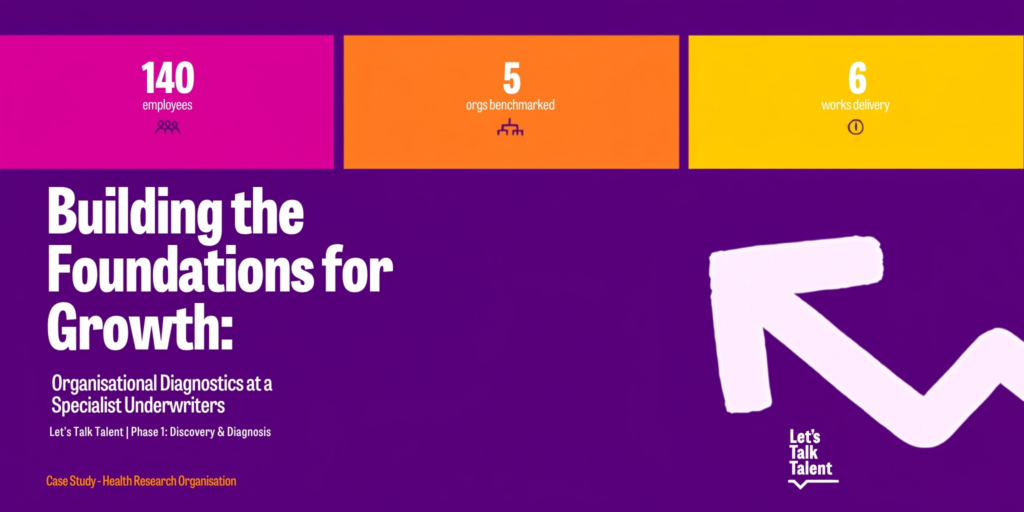
Building the foundations for growth: organisational diagnostics at a specialist underwriter—a full diagnostic that gave the leadership team a genuine evidence base for their people priorities before they invested a penny.
Designing a future-ready operating model for the UK’s largest health research organization—structure, roles, and ways of working redesigned around where the organisation was heading, not where it had been.
Transformative organisational design to enable future growth—a redesign that removed duplication and gave people clearer accountability and clearer career routes.
More client work sits in our case study library.
People & Team Development Resources
We publish practical guidance for HR leaders, people directors, and team managers who have to make development work with real budgets and real diaries. Start with these.
EVP examples that work—real employee value propositions pulled apart, with what makes them credible rather than aspirational.
How to ensure your onboarding experience is exceptional—a practical structure for the first 90 days, including hybrid and remote starters.

Why company succession planning could save your business—the risk of an unmapped leadership bench, and how to start mapping one.
10 questions every leader should be asking about talent—a boardroom-ready set of prompts for your next people strategy conversation.
Everything else lives in our learning and insight hub.